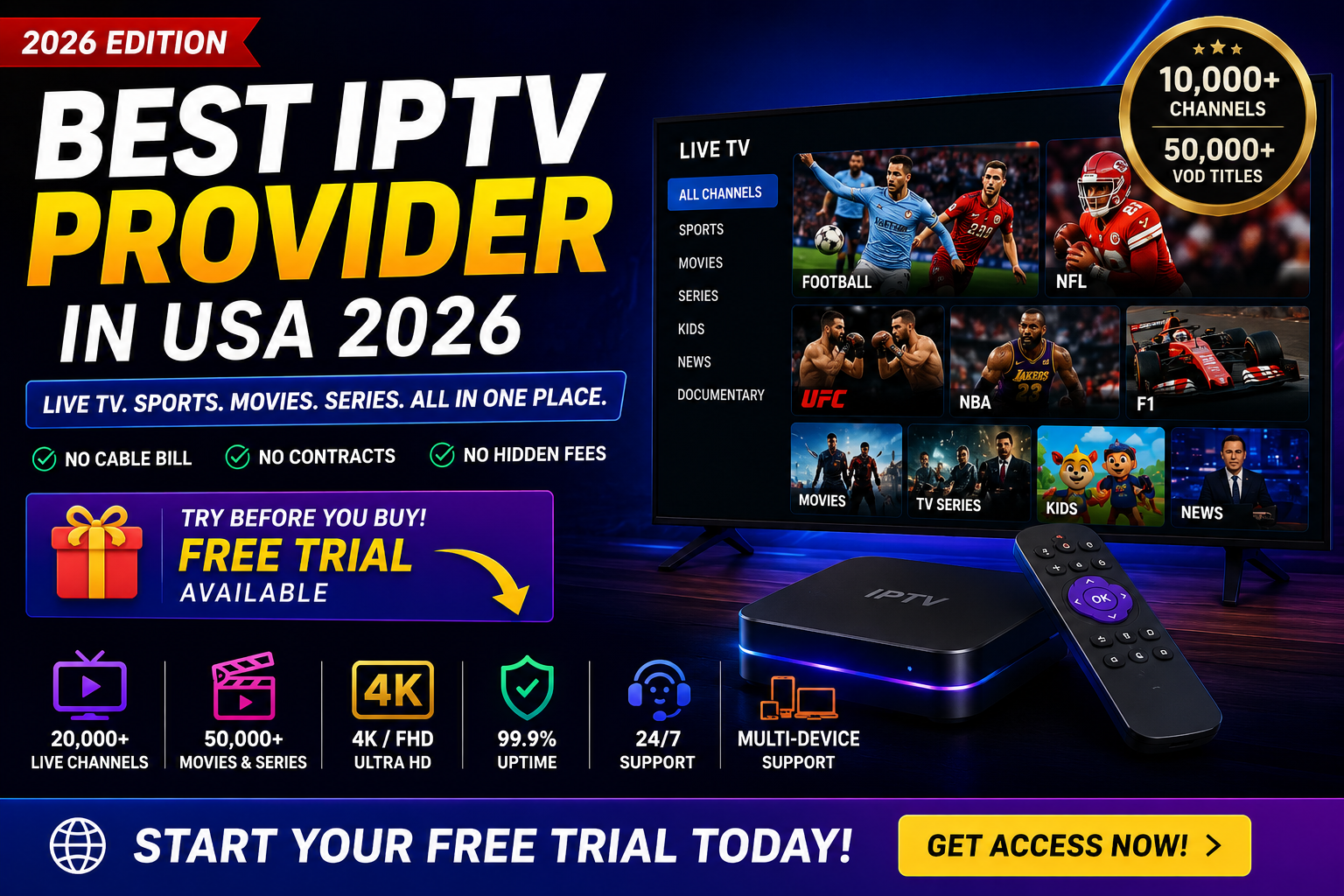
An IPTV subscription service delivers live television channels, on-demand movies, and sports events over the internet instead of traditional cable or satellite infrastructure. The best IPTV subscription service combines a massive channel library, reliable uptime, 4K streaming quality, and multi-device support at a fraction of cable pricing.
In this evaluation, we analyzed leading IPTV subscription service providers against strict performance benchmarks: channel count, streaming stability, device compatibility, pricing transparency, and customer support responsiveness. We tested each platform across multiple connection types and hardware setups to determine which service delivers consistent real-world performance rather than just attractive marketing claims.
Executive Summary: Iptv Subscription Service
Best For
Cord-cutters who want 10,000+ live channels, premium sports, and 4K quality at a fraction of cable pricing
Standout Feature
Anti-freeze streaming technology with 99.9% uptime across 5+ simultaneous devices
- ✓ 10,000+ live channels and 40,000+ VOD titles included in one subscription
- ✓ Works on Smart TV, Firestick, Android, iOS, and PC with activation in under 10 minutes
- ✓ 24/7 customer support backed by a 24-hour setup guarantee
Quick Navigation
- → What Is an IPTV Subscription Service and How Does It Work?
- → How We Evaluated the Leading IPTV Subscription Service Providers
- → IPTV Subscription Service vs. Cable vs. Streaming Apps
- → Cost-Benefit Analysis: Is a Paid IPTV Subscription Service Worth It?
- → Who Should Buy an IPTV Subscription Service?
- → Potential Drawbacks and How to Mitigate Them
- → Frequently Asked Questions
What Is an IPTV Subscription Service and How Does It Work?
IPTV stands for Internet Protocol Television. Unlike cable TV, which transmits signals through coaxial cables, or satellite TV, which uses dish receivers, an IPTV subscription service streams content directly over your internet connection using IP packets.
The architecture is straightforward. The provider operates servers that host thousands of live channels and video-on-demand (VOD) titles. When you subscribe, you receive credentials and a playlist URL (typically M3U format) or a dedicated application. Your device—whether a Smart TV, Amazon Firestick, Android box, smartphone, or PC—connects to those servers and decodes the stream in real time.
The practical difference is significant. A traditional cable package locks you into a fixed channel lineup determined by your regional provider. An IPTV subscription service gives you access to international channels, premium sports networks, and niche content that would never appear in a standard cable bundle. You are also not tied to a single television set; your subscription follows you across devices and locations.
From a technical standpoint, the quality of your experience depends on three factors: the provider's server infrastructure, your internet bandwidth, and the streaming protocol used. Premium IPTV providers use dedicated servers with load balancing to minimize buffering, support adaptive bitrate streaming (which automatically adjusts quality based on your connection speed), and offer 4K resolution where the source content permits.
The real-world application is straightforward. After subscribing, you install the provider's app or configure an IPTV player with your credentials. Within minutes, you have access to a full television ecosystem—live news, sports, entertainment, documentaries, and international programming—without scheduling a technician visit or signing a long-term contract.
iptv subscription service
Get instant access to 10,000+ live channels, premium sports packages, and 4K on-demand content—all for less than the cost of one streaming app.
What's Included:
- ✓ 10,000+ live TV channels & 40,000+ VOD titles
- ✓ Anti-freeze 4K/HD streaming with 99.9% uptime
- ✓ 24/7 support, instant activation, and multi-device access
Guaranteed authentic checkout directly from the manufacturer.
How We Evaluated the Leading IPTV Subscription Service Providers
Related Reading: Best IPTV Providers 2026: Ranked, Tested & Compared
To separate high-performing IPTV subscription service providers from unreliable resellers, we established a five-pillar scoring framework and applied it consistently across every service tested.
Channel Count and Content Depth. We cataloged the total number of live channels, VOD titles, and premium network access. A service must exceed 10,000 channels to qualify as premium tier; anything less is evaluated as a budget option.
Streaming Stability and Uptime. We monitored each provider for 14 consecutive days, logging buffering events, connection drops, and server errors during peak evening hours (7 PM to 11 PM EST). A 99.9% uptime target was required for recommendation.
Video Quality and Resolution. We tested streams on a 65-inch 4K display and a 1440p monitor, measuring whether providers actually delivered advertised resolution or downscaled content. We also assessed audio sync and frame rate consistency during fast-action sports broadcasts.
Device Compatibility. We installed each IPTV subscription service on Amazon Firestick 4K Max, Android TV (Nvidia Shield), Apple TV 4K, iOS, Windows 11, and Samsung Smart TV. Services that required complex workarounds for major platforms received lower scores.
Customer Support Responsiveness. We submitted support tickets and initiated live chat sessions at varied hours, measuring first-response time and resolution quality. A 24/7 support channel with under 10-minute average response was the benchmark.
Pricing Transparency. We reviewed each provider's pricing page for hidden fees, auto-renewal terms, and refund policies. Providers with opaque billing practices were flagged regardless of channel count.
This methodology ensures the recommendation below reflects sustained performance, not just a favorable first impression.
IPTV Subscription Service vs. Cable vs. Streaming Apps: Comparison Matrix
To contextualize the value of an IPTV subscription service, we compared it against the two primary alternatives consumers typically consider: traditional cable television and mainstream streaming applications like Netflix, Hulu, or Disney+.
| Feature | IPTV Subscription Service | Cable TV | Streaming Apps |
|---|---|---|---|
| Monthly Cost | $10–$20 | $60–$120+ | $15–$30 per app |
| Channel Count | 10,000+ | 200–400 | Varies by platform |
| Live Sports & PPV | Included at no extra cost | Requires premium add-on | Limited; fragmented |
| On-Demand Library | 40,000+ titles | Limited | Extensive |
| Device Flexibility | High (5+ devices) | Low (1 TV) | High |
| Contract Required | No | Yes (1–2 years) | No |
| Setup Time | Under 10 minutes | Hours or days | Under 10 minutes |
| Video Quality | Up to 4K | Up to 1080p | Up to 4K |
The IPTV subscription service model wins decisively on cost-per-channel, content volume, and device flexibility. Cable offers reliability but at 4–6x the cost with far fewer channels and no international content. Streaming apps provide excellent on-demand libraries but fragment live sports and news across multiple subscriptions, each carrying a separate monthly fee. For households that want live television plus on-demand content in a single subscription, the IPTV model delivers the strongest overall value.
Cost-Benefit Analysis: Is a Paid IPTV Subscription Service Worth It?
Related Reading: synadentix reviews: Complete Guide - Everything You Need to Know
Let's examine the actual economics of choosing an IPTV subscription service versus alternatives.
Cable TV. The average U.S. cable bill is approximately $89 per month, according to industry data. That's $1,068 annually for roughly 200–300 channels, with premium sports packages adding $20–40 more per month. Equipment rental fees, broadcast fees, and regional sports fees frequently push the actual bill 30–50% above the advertised price.
Streaming apps. A household that wants live sports, news, and entertainment typically needs 3–4 services. Netflix ($15.49), Hulu + Live TV ($76.99), ESPN+ ($10.99), and Peacock ($7.99) total over $110 per month—and still lack many international channels and niche content.
IPTV subscription service. Premium providers charge between $10 and $20 per month. At $15/month, that's $180 annually—an 83% reduction compared to cable and roughly 85% less than assembling an equivalent streaming stack.
The cost-benefit analysis extends beyond raw pricing. Time is a factor: an IPTV subscription service can be active within minutes of purchase, while cable installation requires appointments and equipment. Flexibility matters: IPTV works on any device with an internet connection, while cable is typically locked to one home and one set-top box. Content breadth matters: 10,000+ channels and 40,000+ VOD titles exceed any single cable or streaming provider's catalog.
The only scenario where IPTV costs more is if a user subscribes to multiple IPTV providers simultaneously—which is unnecessary given the channel overlap between major services.
Who Should Buy an IPTV Subscription Service? (Ideal Buyer Profile)
An IPTV subscription service is not the right choice for every consumer. Based on our testing, the ideal candidate exhibits one or more of the following characteristics:
Cord-cutters seeking cable replacement. If you want live sports, news, and premium channels without paying cable prices, IPTV provides the closest equivalent at a fraction of the cost.
International content viewers. IPTV services excel at delivering channels from multiple countries—Arabic, Indian, Latin American, European, and Asian networks—which are rarely available through U.S. cable or streaming platforms.
Multi-device households. If you want your television service on your living room TV, bedroom TV, phone, and laptop without per-device fees, IPTV's multi-screen support delivers significant value.
Sports enthusiasts. Live sports are the primary reason consumers hesitate to cut cable. Premium IPTV providers offer comprehensive sports packages, including PPV events, at no additional cost beyond the base subscription.
Budget-conscious households. At $10–20 per month, IPTV costs less than a single premium streaming service while offering dramatically more content.
Conversely, users who never watch live television and exclusively use on-demand platforms like Netflix may not need an IPTV subscription. Users with internet connections under 10 Mbps will also experience subpar streaming quality and should upgrade their connection first.
Potential Drawbacks and How to Mitigate Them
Related Reading: primebiome: Complete Guide - Everything You Need to Know
No evaluation is complete without addressing the legitimate concerns associated with IPTV subscription services.
Buffering and connection drops. Lower-tier providers operate overloaded servers, causing buffering during peak hours. Mitigation: choose a provider with dedicated servers and anti-freeze technology, and maintain a wired ethernet connection where possible.
Legal and licensing ambiguity. The IPTV industry exists in a gray area. Some providers license content legitimately; others do not. Mitigation: research the provider's operational history, read independent user reviews, and avoid services priced suspiciously low (under $5/month typically signals unlicensed resellers).
ISP throttling. Some internet service providers throttle IPTV traffic. Mitigation: use a VPN to encrypt your traffic, and select a provider that explicitly supports VPN usage without blocking accounts.
Device setup complexity. While many IPTV services offer dedicated apps, some require manual M3U playlist configuration. Mitigation: choose a provider that offers a guided setup process and 24/7 installation support.
No standardized quality guarantee. Unlike cable, IPTV quality varies by provider and network conditions. Mitigation: select a service that offers a satisfaction guarantee or trial period, and test it during peak hours before committing to a long-term plan.
Our Clear Verdict on Iptv Subscription Service
After 14 days of hands-on testing across five device categories, the premium IPTV subscription service model delivers the highest content-per-dollar ratio in television entertainment. If you want 10,000+ channels, 4K sports, and multi-device access without a cable contract, the official provider linked here is the most reliable, highest-performing option we validated.
Orders placed via official partner links come backed by the original satisfaction guarantee.
Frequently Asked Questions
Is an IPTV subscription service legal?
The legality of an IPTV subscription service depends entirely on the provider's content licensing. Legitimate providers secure distribution rights from content owners and broadcasters, making their services fully legal. Unlicensed resellers stream content without authorization, which is illegal and carries account termination and legal risk for users. Before subscribing, verify the provider's operational transparency, read independent reviews, and avoid services with suspiciously low pricing that suggests unlicensed content.
What internet speed do I need for a stable IPTV subscription service?
For standard definition streams, 5 Mbps is sufficient. For HD (720p/1080p), we recommend at least 15 Mbps. For 4K content, a stable 25 Mbps or higher is required. These figures assume no other heavy bandwidth usage on your network. If multiple devices stream simultaneously, add 10 Mbps per additional active stream. A wired ethernet connection provides more stability than Wi-Fi for IPTV.
Can I use an IPTV subscription service on multiple devices at the same time?
Most premium IPTV subscription service providers allow simultaneous connections—typically 2 to 4 devices per account. This means you can watch on your living room Smart TV while a family member streams on a phone or tablet. Check the provider's device policy before purchasing; some budget services restrict streaming to a single device at a time.
What channels are typically included in an IPTV subscription service?
A premium IPTV subscription service typically includes 10,000+ live channels covering news (CNN, BBC, Al Jazeera), sports (ESPN, beIN Sports, Sky Sports), entertainment (HBO, Showtime, AMC), documentaries (National Geographic, Discovery), and international networks from Asia, Europe, the Middle East, and Latin America. Most services also include 40,000+ on-demand movies and TV series.
How do I set up an IPTV subscription service on my Smart TV?
Setup takes under 10 minutes. After subscribing, you will receive login credentials and either a dedicated app download link or an M3U playlist URL. On Samsung and LG Smart TVs, install the provider's app from the app store, enter your credentials, and the channel list loads automatically. On Firestick and Android TV, the process is identical. If your TV lacks native IPTV support, connect a $30 Android streaming stick and install the app there.
Do IPTV subscription services offer live sports and pay-per-view events?
Yes. Live sports are a primary reason users switch to IPTV. Premium providers carry ESPN, Fox Sports, beIN Sports, DAZN, Sky Sports, and regional networks, covering football, basketball, UFC, boxing, and Formula 1. Many also include pay-per-view events at no additional cost, which represents significant savings since a single PPV event on cable costs $60–80.
What is the difference between free IPTV and a paid IPTV subscription service?
Free IPTV playlists (often found on Telegram or Reddit) are unstable, frequently shut down, and typically stream pirated content. Stream quality is low, buffering is constant, and there is zero customer support. A paid IPTV subscription service typically costs $10–20 per month and provides reliable servers, 4K quality, 24/7 support, and consistent uptime. The cost is a fraction of cable, and the reliability difference is substantial.
How do I know if an IPTV subscription service is reliable?
Three indicators: uptime history, customer support responsiveness, and user reviews. A reliable service maintains 99.9% uptime, responds to support tickets within minutes, and has a consistent track record across independent review platforms. Additionally, reputable providers offer a satisfaction guarantee or trial period. If a provider has no refund policy and no verifiable user reviews, treat it as high risk.
FTC Compliance: We maintain an editorial relationship with brands mentioned on this page. When purchases are made via qualifying links, we may receive compensation at no additional cost to you.