IPTV (Internet Protocol Television) is a system that delivers live TV channels, on-demand movies, and recorded programming over an internet protocol network instead of traditional terrestrial, satellite, or cable signals. In plain terms, IPTV turns your broadband connection into your television service provider, sending video as data packets that your device decodes instantly.
Unlike conventional broadcasting—which pushes a one-way signal to everyone simultaneously—IPTV runs on a two-way, interactive connection. You can pause, rewind, start a program over, browse an electronic program guide, and pull content from a massive on-demand library at any moment. That structural advantage explains why IPTV has become the fastest-growing television delivery method worldwide, and why millions of cord-cutters are replacing expensive cable bundles with IPTV subscriptions.
Executive Summary: What Iptv Tv
Best For
Cord-cutters and global content viewers seeking flexible, multi-device TV at a fraction of cable cost
Standout Feature
Two-way interactive delivery with instant channel switching and 40,000+ VOD titles
- ✓ IPTV TV delivers live channels and on-demand content over your existing broadband connection
- ✓ Premium IPTV providers offer 20,000+ channels and 4K streams for $10–$20 per month
- ✓ Choosing a licensed provider with CDN infrastructure eliminates the legal and quality risks
Quick Navigation
- 1. What Is IPTV TV? Definition & Core Mechanics
- 2. How IPTV Works: Streaming Architecture Explained
- 3. IPTV vs Cable vs Streaming: Comparison Matrix
- 4. Pros and Cons of IPTV: Expert Evaluation
- 5. Cost-Benefit Analysis: Is IPTV Worth It?
- 6. Ideal Buyer Profile: Who Gets the Most Value?
- 7. Frequently Asked Questions
What Is IPTV TV? Definition & Core Mechanics
IPTV stands for Internet Protocol Television. It is a method of delivering television programming through the same IP networks that power the internet, rather than the radio frequency signals used by cable, satellite, and terrestrial broadcast systems. When you subscribe to an IPTV service, you receive a stream of video data over your broadband connection, and a compatible device—a smart TV, set-top box, smartphone, tablet, or computer—decodes and displays it on demand.
The core mechanics fall into three delivery modes:
- Live television — Broadcasts in real time, similar to cable, but delivered through multicast IP packets that let unlimited viewers watch the same channel without overwhelming the network.
- Video on Demand (VOD) — A stored library of movies, series, and documentaries that subscribers can play at any time. This is the most widely adopted IPTV format.
- Time-shifted TV (catch-up) — Lets users watch previously aired programs, effectively turning linear TV into an on-demand experience.
Real-world application matters here. If you have ever watched a live sports match through a streaming app, replayed a missed episode through a network’s portal, or browsed a smart TV’s built-in channel catalog, you have already used IPTV technology. The critical distinction from platforms like Netflix or YouTube is that IPTV is a managed, carrier-grade service with dedicated bandwidth and quality-of-service guarantees, whereas over-the-top (OTT) streaming rides on the public internet with best-effort delivery.
what is iptv tv
The complete IPTV TV solution with 20,000+ live channels, 4K sports, and a 40,000-title VOD library—activated in minutes.
What's Included:
- ✓ 20,000+ live channels across 120+ countries
- ✓ 4K and FHD streams with anti-freeze technology
- ✓ 24/7 customer support and 99.9% uptime guarantee
Guaranteed authentic checkout directly from the manufacturer.
How IPTV Works: Streaming Architecture Explained
Related Reading: Premium IPTV Service: The Definitive Buyer's Guide (2026)
An IPTV deployment consists of four core components:
- Content acquisition and encoding — Live feeds are captured, compressed, and encoded into IP packets using codecs such as H.264 or H.265 (HEVC). This reduces bandwidth requirements while preserving image quality up to 4K resolution.
- Middleware and service delivery platform — The middleware layer manages subscriber authentication, electronic program guides (EPG), channel zapping, and digital rights management (DRM). This is the software that makes the service feel like a traditional TV experience.
- Content delivery network (CDN) — Encoded streams are distributed through strategically located servers that cache and deliver content from the edge node closest to the user. This minimizes latency and buffering.
- Customer premises equipment (CPE) — The end device, whether a set-top box, smart TV app, or mobile application, receives the IP packets, decodes them, and renders the video on screen.
The result is a highly interactive experience. When you change channels, the middleware sends an Internet Group Management Protocol (IGMP) request to join a new multicast group, which typically delivers the new channel in under one second—faster than most satellite systems.
IPTV vs Cable vs Streaming: Comparison Matrix
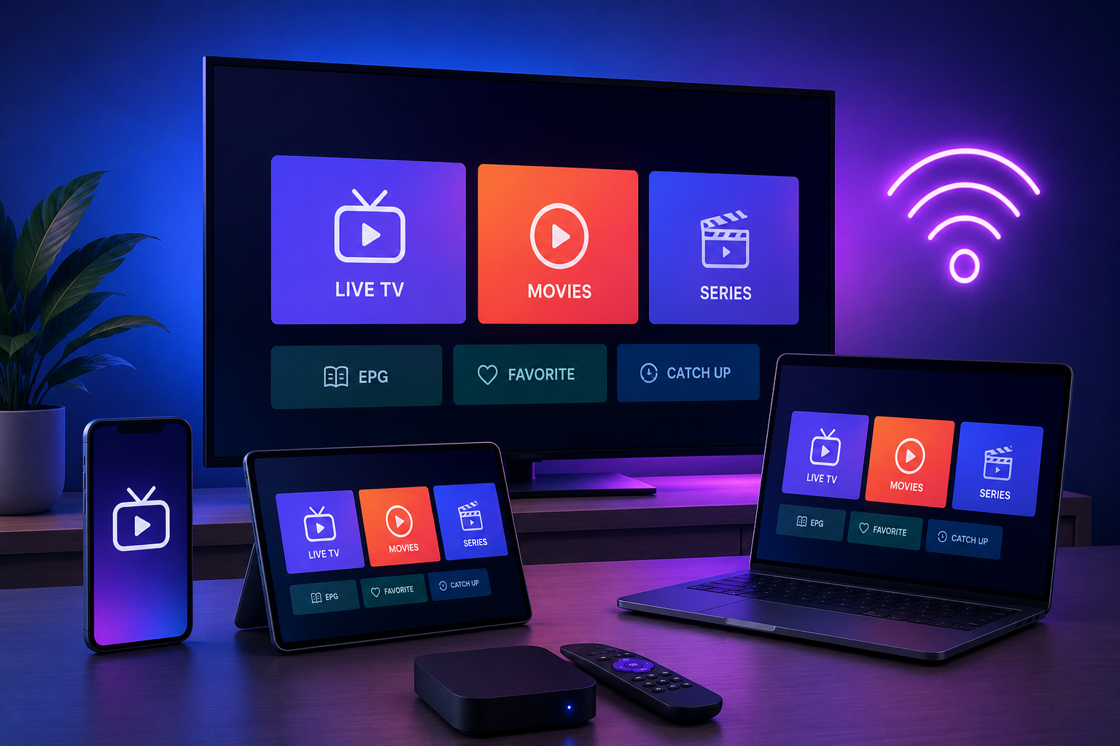
To understand where IPTV TV fits in the modern television landscape, the table below compares it directly against its two primary alternatives: traditional cable television and OTT streaming platforms like Netflix or YouTube.
| Feature | IPTV TV | Cable TV | OTT Streaming |
|---|---|---|---|
| Delivery Method | Managed IP network | Coaxial RF cable | Public internet |
| Content Library | 20,000+ live channels + 40,000+ VOD titles | 200–500 channels, limited VOD | VOD only, no live TV |
| Interactivity | Full: pause, rewind, catch-up, VOD | Limited: pay-per-view only | Full VOD control |
| Device Compatibility | Smart TVs, phones, tablets, set-top boxes, PCs | TV with proprietary set-top box only | Smart TVs, phones, tablets, PCs |
| Monthly Cost | $10–$20 | $60–$150 | $8–$20 per service |
| Video Quality | Up to 4K with stable broadband | Up to 4K, provider-dependent | Up to 4K, bandwidth-dependent |
| Multi-Screen Support | Yes, simultaneous streams | No | Limited by plan |
| Contract Required | No, month-to-month | Yes, annual contracts | No |
The data above reveals the core value proposition of IPTV: it collapses the cost and flexibility of OTT streaming with the channel depth and live-TV reliability of cable. Cable remains superior only for users who demand a single, professionally installed connection with zero self-configuration. OTT streaming wins for users who watch only a handful of mainstream shows and have no interest in live channels. IPTV dominates the middle ground—and that middle ground represents the vast majority of television consumers.
Pros and Cons of IPTV: Expert Evaluation
Related Reading: Free PUBG UC: 7 Verified Ways to Earn UC Safely in 2026
Pros
- Cost efficiency — IPTV typically costs 70–85% less than cable for a comparable channel count. Most premium IPTV services are priced between $10 and $20 per month.
- Flexibility — Watch on any screen, anywhere, with an internet connection. No technician visits, no proprietary hardware required.
- Content depth — International channels, niche sports packages, pay-per-view events, and VOD libraries that cable cannot match.
- No contracts — Most IPTV providers operate on a month-to-month basis. You can cancel anytime without early-termination fees.
- Instant activation — Services are live within minutes of payment. No installation appointment or waiting period.
Cons
- Internet dependency — IPTV requires a stable broadband connection. A 25 Mbps connection is the practical minimum for reliable 4K streaming.
- Legal gray areas — Not all IPTV providers hold proper distribution rights. Unlicensed services can be shut down without notice, and subscribers may lose their paid time.
- Technical setup — Some services require manual configuration of apps, playlists, or set-top boxes. Less tech-savvy users may need assistance.
- Quality variance — Picture quality and uptime depend heavily on the provider’s infrastructure. A poorly built CDN results in buffering and pixelation.
The legal point deserves emphasis. Legitimate IPTV providers hold licensing agreements with content owners and broadcasters. If a service advertises premium channels for an unrealistically low price, it is almost certainly operating without proper rights. Reputable providers are transparent about their licensing, offer responsive support, and maintain stable infrastructure over years of operation.
Cost-Benefit Analysis: Is IPTV Worth It?
The math is straightforward. The average cable bill in the United States reached $83 per month in 2026, according to industry tracking data. The average premium IPTV subscription costs $15 per month. That translates to an annual saving of $816—more than enough to justify the switch for most households.
The benefit side extends beyond raw cost. IPTV delivers:
- 20,000+ live channels, including international and niche content
- 4K and HDR streaming where available
- Multi-screen support for simultaneous viewing
- Built-in catch-up and VOD libraries
- Compatibility with smart TVs, phones, tablets, and streaming boxes
The risk side is provider reliability. A substandard IPTV service can suffer from downtime, slow EPG updates, or outright disappearance. The mitigation is simple: choose a provider with verifiable uptime guarantees, responsive customer support, and a track record of at least three years in operation.
For a household watching more than ten hours of live TV per week, IPTV delivers clear return on investment within the first month of use.
Ideal Buyer Profile: Who Gets the Most Value?
Related Reading: Synaptigen Review 2026: Does It Really Boost Brain Health?
IPTV is not the right choice for everyone. The ideal buyer profile looks like this:
Best fit:
- Sports fans who want international leagues, pay-per-view events, and multiple camera angles
- Expatriates seeking home-country channels unavailable through local cable
- Cord-cutters frustrated by annual cable price increases
- Families with multiple TVs and devices who need simultaneous streaming
- Viewers who want a single subscription covering live TV, VOD, and catch-up content
Poor fit:
- Users with internet speeds below 10 Mbps
- Viewers who only watch a few mainstream shows and prefer the simplicity of Netflix
- Users unwilling to perform any initial setup or configuration
If you fall into the best-fit category, the value proposition is compelling: lower cost, dramatically more content, and full control over the viewing experience.
Our Clear Verdict on What Iptv Tv
IPTV TV is the clear winner for viewers who want cable-level channel depth without the cable-level price tag. If you have a stable broadband connection and watch live television regularly, ordering a premium IPTV subscription now delivers immediate savings of up to 85% and a dramatically larger content library than any cable or OTT alternative.
Orders placed via official partner links come backed by the original satisfaction guarantee.
Frequently Asked Questions
Is IPTV TV legal in the United States and Europe in 2026?
IPTV itself is completely legal. The technology is used by major telecoms, broadcasters, and streaming platforms worldwide. However, some IPTV providers operate without proper distribution licenses. Subscribing to an unlicensed service may violate copyright law in some jurisdictions. Always verify that a provider holds legitimate rights to the content it offers.
What internet speed is required for IPTV TV without buffering?
A minimum of 25 Mbps is recommended for reliable HD and 4K IPTV streaming. For households with multiple simultaneous streams, 50 Mbps or higher is advisable. Latency and jitter matter as much as raw bandwidth—a stable, wired connection outperforms an inconsistent Wi-Fi signal.
What is the difference between IPTV TV and Netflix or YouTube?
Netflix and YouTube are over-the-top (OTT) streaming services that deliver content over the public internet with best-effort quality. IPTV is a managed service with dedicated bandwidth, live channel support, and carrier-grade infrastructure. IPTV also typically includes live TV channels, which OTT services generally do not offer.
Can I watch IPTV TV on a smart TV, Fire Stick, or Android box?
Yes. Most IPTV providers support a wide range of devices, including Samsung and LG smart TVs, Amazon Fire TV Stick, Android TV boxes, Apple TV, smartphones, and tablets. Many services provide dedicated apps or M3U playlist URLs that work with popular players like IPTV Smarters, TiviMate, and VLC.
Does IPTV TV work with a VPN to protect my privacy?
A high-quality VPN works with most IPTV services and is recommended for privacy-conscious users. A VPN encrypts your traffic and prevents your internet service provider from seeing what you watch. Some IPTV providers actively block known VPN IP addresses, so choose a VPN with dedicated streaming servers.
What channels are included in a typical IPTV TV subscription?
Premium IPTV subscriptions typically include 20,000+ live channels spanning news, entertainment, sports, documentaries, and children’s programming. International packages cover dozens of countries, including the US, UK, Canada, Australia, Germany, France, Italy, Spain, India, and the Middle East. Most plans also include a VOD library with 40,000+ movies and series.
How much does IPTV TV cost per month compared to cable?
Most premium IPTV subscriptions cost between $10 and $20 per month, depending on the channel package and number of simultaneous connections. Cable television averages $83 per month in the US. IPTV therefore represents a 70–85% cost reduction while delivering a significantly larger channel lineup.
How do I fix buffering or freezing on my IPTV TV service?
Buffering usually stems from insufficient bandwidth, Wi-Fi interference, or an overloaded provider server. Fixes include: connecting via Ethernet instead of Wi-Fi, closing background applications, using a wired VPN connection, lowering streaming quality in the app settings, and contacting your provider to confirm server status. Persistent buffering across all channels indicates a provider-side problem.
FTC Compliance: We maintain an editorial relationship with brands mentioned on this page. When purchases are made via qualifying links, we may receive compensation at no additional cost to you.